
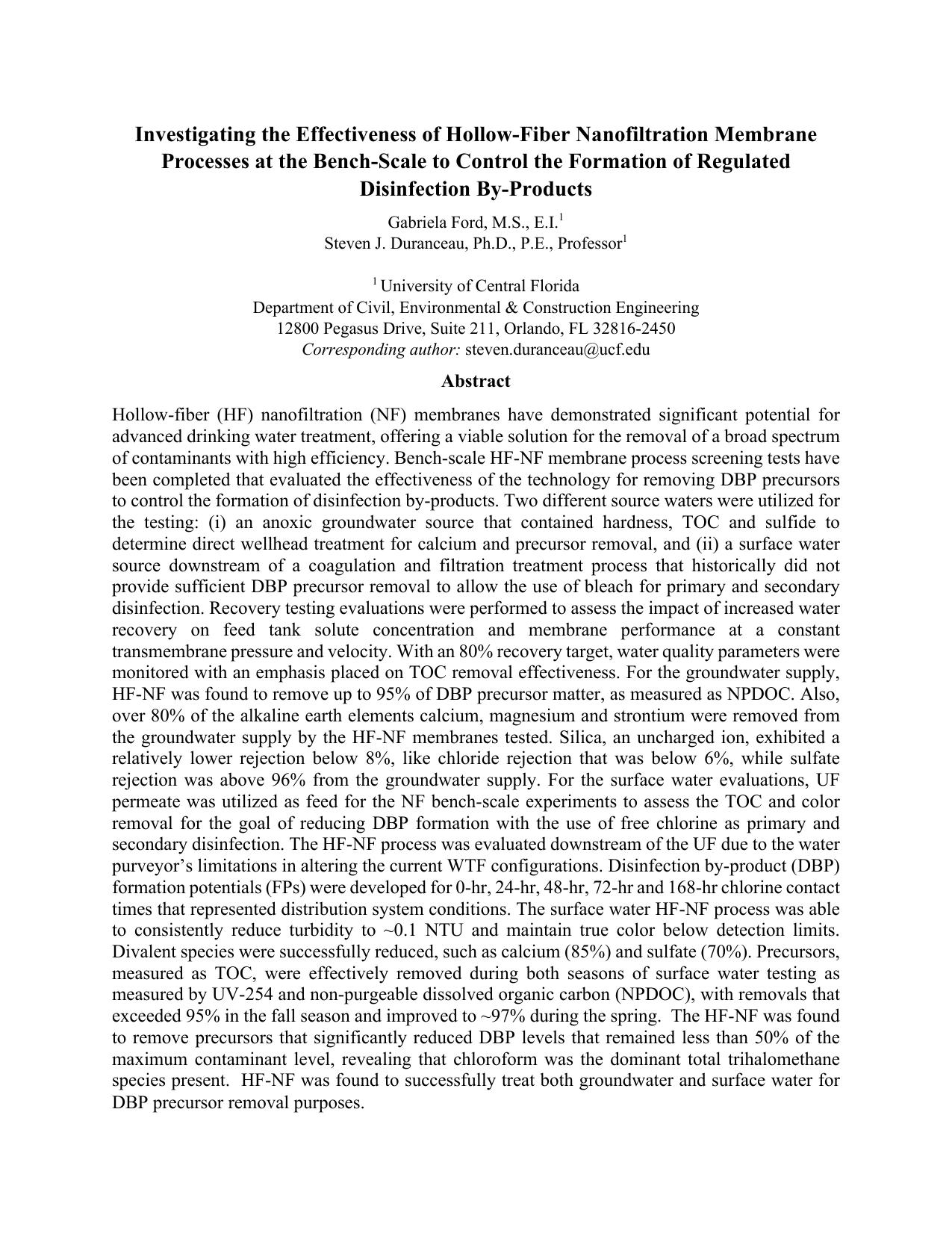
Hollow-fiber (HF) nanofiltration (NF) membranes have demonstrated significant potential for advanced drinking water treatment, offering a viable solution for the removal of a broad spectrum of contaminants with high efficiency. Bench-scale HF-NF membrane process screening tests were conducted to evaluate the effectiveness of the technology for removing disinfection by-product (DBP) precursors and controlling DBP formation. Two source waters were tested: (i) an anoxic groundwater supply containing hardness, TOC, and sulfide, evaluated for direct wellhead treatment and precursor removal; and (ii) a surface water source downstream of a coagulation and filtration process that historically could not support bleach disinfection due to insufficient DBP precursor removal. Recovery testing was performed at an 80% target recovery to assess the impact on feed tank solute concentration and membrane performance at constant transmembrane pressure and velocity. For the groundwater supply, HF-NF removed up to 95% of DBP precursor matter (measured as NPDOC) and over 80% of alkaline earth elements calcium, magnesium, and strontium, while chloride rejection remained below 6% and sulfate rejection exceeded 96%. For the surface water supply, HF-NF reduced turbidity to ~0.1 NTU, maintained true color below detection limits, achieved TOC removals exceeding 95% in fall and ~97% in spring, and reduced DBP formation potential to levels below 50% of maximum contaminant limits. Chloroform was identified as the dominant trihalomethane species. HF-NF was demonstrated to be effective for DBP precursor removal from both groundwater and surface water sources.
Investigating the Effectiveness of Hollow-Fiber Nanofiltration Membrane
| Details | |
|---|---|
| First Name | Gabriela / Steve |
| Last Name | Ford / Duranceau |
| Keywords | Hollow-Fiber Nanofiltration, Disinfection By-Product (DBP) Precursor Removal, Bench-Scale Membrane Performance |
| Year | 26 |
| File | Final_Ford-Duranceau_AMTC'26_paper.pdf |
