
Project Objectives Design a 2,000 m3/day (0.53 mgd) desalination plant pretreatment, including backwash treatment and recycle Reverse osmosis (RO) system post-treatment (stabilization and disinfection) All facilities to be located within a 18,400-ft2 (1,710-m2) predesignated area No brine or chemicals discharged to the sea RO brine to be stored and barged to mainland Maximize recovery of the RO system Conventional SWRO System 1st pass elements limited to 1,200 psig feed pressure Recovery of 40-50% depending on feed salinity and temp Brine volume represents 50-60% of feed volume 1st Pass Permeate Cartridge Filter NaOH (if needed) Pretreated Seawater 1st Pass RO 2nd Pass RO Combined Permeate HP Pump MP Pump Boost Scale Inhibitor Pump PX ERD Brine Concentrate recycle Osmotic and Desalination Pressures Osmotic pressure (π) of seawater is 360 – 480 psi (25 – 33 bar) depending on seawater salinity Accounting for π and water permeability of membrane, pressure required to desalinate seawater starts at 800 psig (55 bar) Approaches to Achieving High Recovery With ~45,000 mg/L seawater feed, conventional RO system can only achieve 45 percent recovery (~82,000 mg/L brine TDS) Two approaches evaluated to achieve higher recoveries Ultra-high-pressure RO – UHP-RO First pass using two stages (versus single stage) Stage 1 equipped with conv. elements Stage 2 equipped with UHP elements Osmotically-assisted RO – OARO Couples conv. OARO Concept Manage osmotic pressure differential between feed and permeate to maintain feed pressure <1,200 psig Pressure Feed Pressure Feed Osmotic Perm Pressure Perm Pressure Stg Stg Stg Feed Flow Perm Flow Adapted from Ju et al., Membranes 13 (2023) Adapted from Peters and Hankins, Desalination 458 (2019) Evaluation Criteria Maximize desalination system recovery Meet product water quality goals Boron <1 mg/L over life of membranes Degree of pre-filtration and associated waste streams Operational complexity Technology risk Safety risk Brine precipitation management Process area requirements Costs OARO Brine Precipitation Management OARO use has been focused on treating low-scaling brines Brine mining concentrating monovalent rich streams produced by nanofiltration Lithium concentration In OARO brine (~80% recovery), several salts are supersaturated Brine must be stored for up to 5 days prior to barging AWC tested candidate scale inhibitors on the simulated brine Successfully ID’d a product that inhibited for 48 hours At high dose, possibly could inhibit for required 5 days of storage Considered a major process risk.
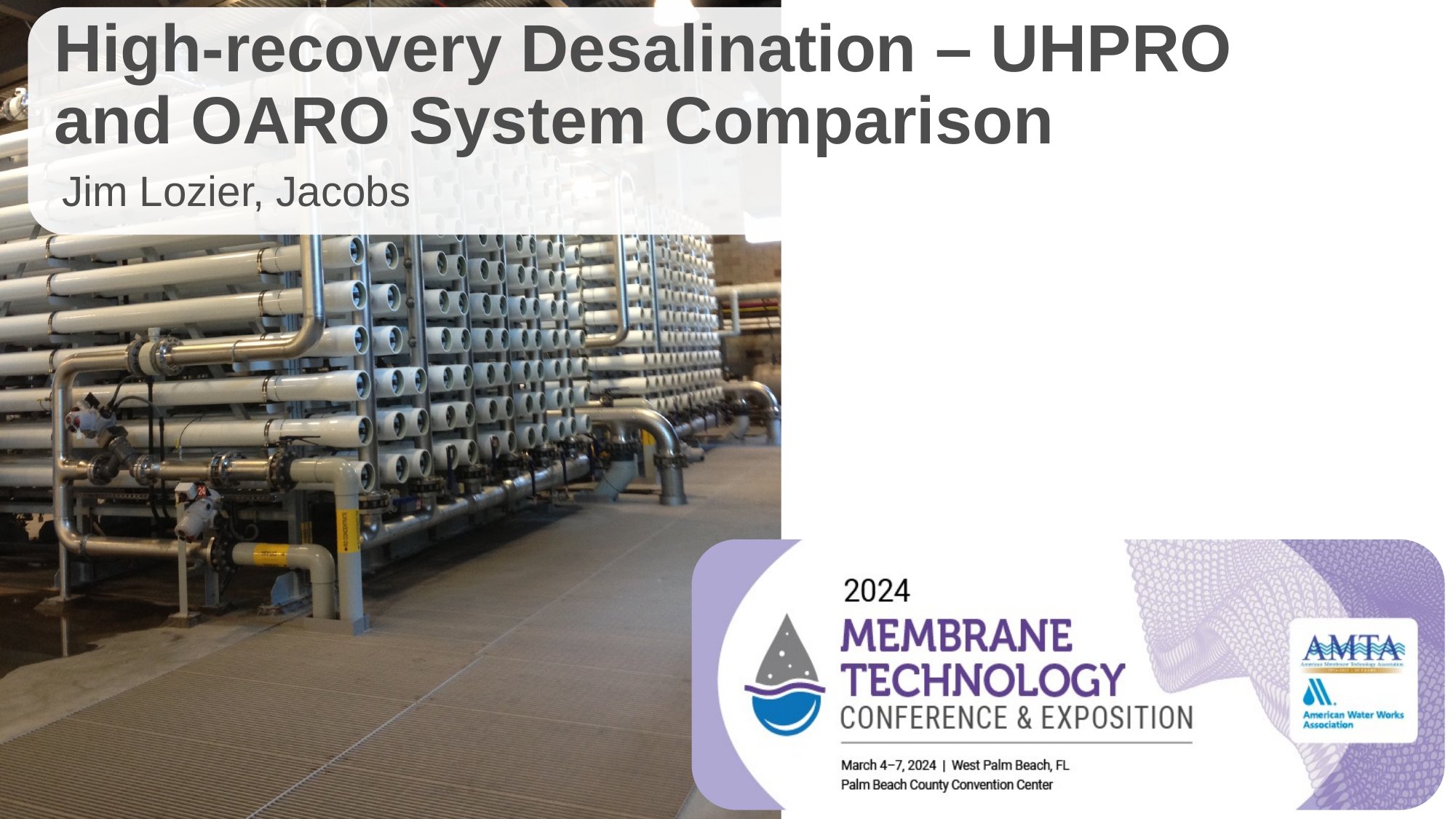
Achieving High-Recovery Seawater Desalination – Comparison of Ultra-High Pressure and Osmotically Assisted Reverse Osmosis
| Details | |
|---|---|
| First Name | Jim |
| Last Name | Lozier |
| Keywords | Simmermacher, Osmotic Pressure, Reverse Osmosis, Potable Water, Spiral Wound, Desalination, Permeability, Alkalinity, Full-Scale |
| Year | 2024 |
| File | WED08-2_Lozier_revised.pdf |
