
Typical Wastewater Effluent Quality Conventional Compliance of MBR permeate Parameter MBR Effluents Effluents with: Most regional non-potable TSS 25 – 50 mg/L < 2 mg/L guidance Turbidity 10 – NTU < 0. NTU WHO standards for unlimited BOD 25 – 50 mg/L < 2 mg/L irrigation EU Bathing Water Directive TDS N/A N/A California Title Code of Nitrogen 10 – 30 mg/L < 10 mg/L Regulations Phosphorus 1 – 30 mg/L 0.05 – 2 mg/L Coliforms 105 – 107 cfu/100 mL < 2.2 #/100 mL Virus / Protozoa 2.5 / 2 log 5 / 6 log Pathogen Removal Mechanisms in MBR Not the same as removal in UF direct filtration applications Physical Removal Size Exclusion Adsorption onto the membrane Adsorption onto the biomass Biological Predations Higher life forms feeding on pathogens Contribution of the mechanism is pathogen dependent Source: AWWA/AMTA MTC 2021 – MBR in Potable Reuse, A. Assessing Virus & Protozoa Removal at Full Scale MBRs STUDY A Overview: 9 months, 10 sampling events Sampling at varied operating conditions Parameters Sampled Enterococci / Enterovirus / Norovirus / Giardia / Cryptosporidium Hamby WRF – Abilene, TX BOD / COD / Temperature / pH / DO / TDS / Ammonia / Nitrate / Nitrite / TOC /Turbidity / Electrical Conductivity / Particle Counts / UVA / IPR plant discharging to reservoir Fluorescence / ATP SAMPLING DONE ACCORDING TO STANDARD METHODS 45,500 m3/d Start-up: 2015 Ironhouse SD WRF – Oakley, CA Non-potable reuse with T22 effluent 8,700 m3/d Start-up: 2011 Study B – Implications of compromised membranes on pathogen removal Overview of Study: Testing Plan 13 sampling events 1) Characterize Influent Protocol repeated on 2 modules 2) Baseline Performance Targeting turbidity 0.15 – NTU 3) Damage to Elevate Turbidity 4) Repeat Brightwater WRF Pilot – Woodinville, WA System designed to mirror main plant Pilot operation mirrored full scale plant Intentional damage of membrane fibers to simulate impaired performance Full scale modules used Measured array of surrogates Hamby WRF Potable Reuse in Action Location: Abilene, TX, USA Start-up: 2015 Challenge Region experiencing chronic draught and population growth putting area reservoirs at 30% capacity Residents under strict water use restrictions Solution Introducing a sustainable source of freshwater Discharges 26 million liters a day of advanced treated wastewater effluent into the reservoir 60% Reverse Grit DeFacility Removal Osmosis Chlorinat chlorinatio MBR Flowsheet and Fine Biologicall ion n and Post Screening Ozone y Active Aeration Filters 40%.
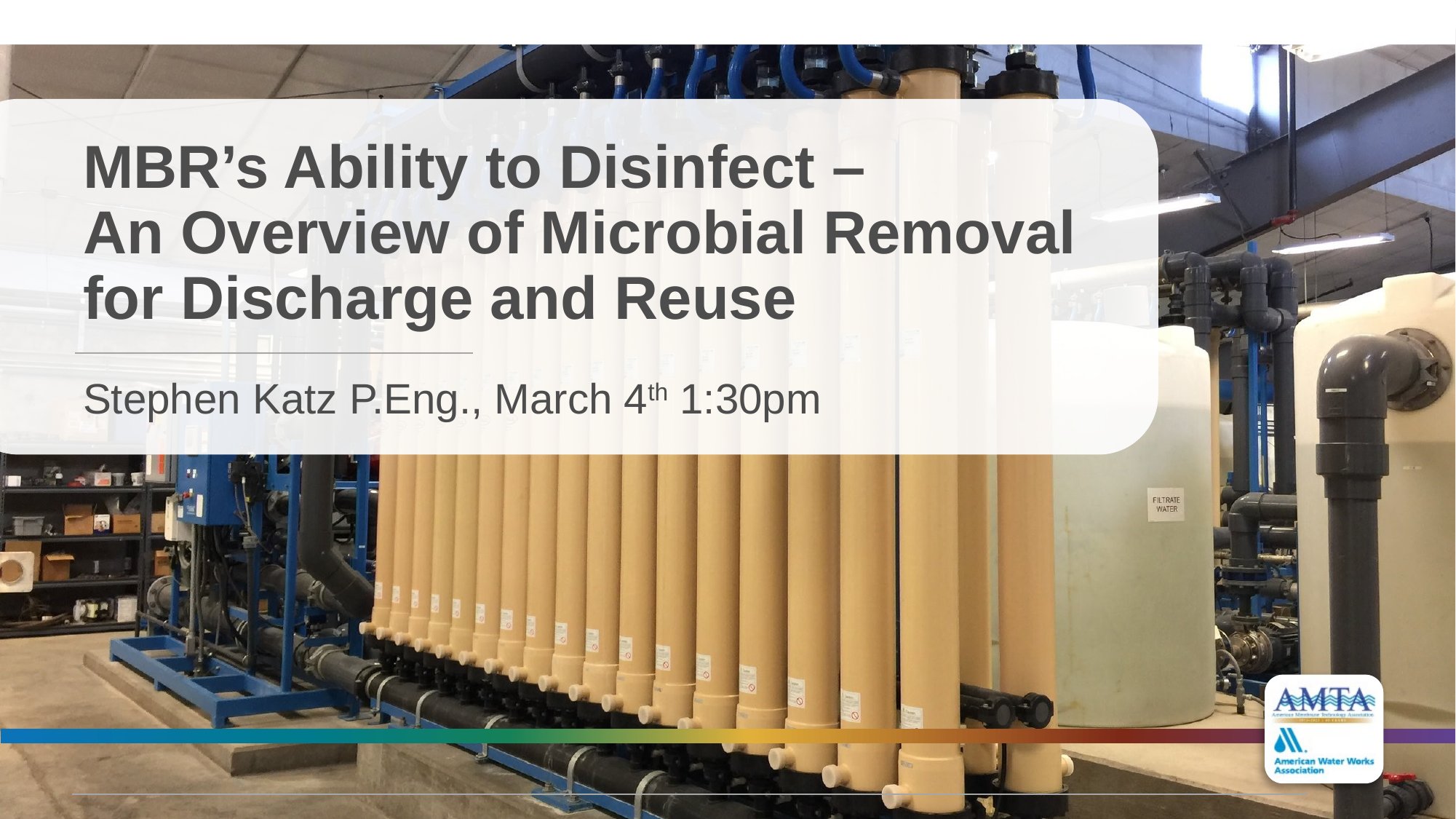
MBR’s Ability to Disinfect – An Overview of Microbial Removal for Discharge and Reuse
| Details | |
|---|---|
| First Name | Stephen |
| Last Name | Katz |
| Keywords | Peach, Szewczyk, Nutrient Removal, Water Recycling, Reclaimed Water, Surface Water, Conductivity, Capital Cost, Hollow Fiber, Groundwater |
| Year | 2024 |
| File | WED11-01_Katz_Stephen.pdf |
