
MBR Benefits The substitution of a membrane separation process for a Excellent Effluent Quality in a secondary clarification and tertiary filtration following a Smaller Footprint biological wastewater treatment process Conventional WW Treatment Biologic Settlin Filtratio al g n MOS MB R WRF @ North Head STP, Sydney, Australia Biologic Membran al e MBR Benefits Rejection 1. MGD/5. MLD SBR 1. MGD/5. MLD MBR Consistent treated water quality Footprint: 35,200 ft2 (3,270 m2) Footprint: 17,325 ft2 (1,610 m2) High rejection efficiency of organic constituents, solids, and microorganisms Construction Smaller than clarifier footprint Reduced biological basin size (higher MLSS) No tertiary clarifier or sand filters Modular plant expansion with common wall construction O&M Highly Automated No sludge “bulking”/settling problems Able to handle sudden flow changes MBR Trends Expansion Footprint limited or expensive real estate Plant expansion in same footprint Upgrading for Future Best Available Technology meets future needs Expansion Automation & programmed labor Ancillaries are smaller & cheaper Disinfection Solids management Regulatory MBR Re-Use Discharge into sensitive waters Future BNR or ENR (TN < 3 and TP < 0.05 mg/l) Effluent quality limits have tightened Water Reuse Aquaculture Irrigation – landscape & agriculture Regu latory Industrial recycling Groundwater recharge & brackish water barrier Non-potable urban (purple pipe) Potable reuse Pre-treatment/ Installation & Biological System Membrane System Monitoring & Control Headworks Commissioning Fine Screening SRT Control Flux design point Functional testing Influent/ Effluent Grit removal Oxygen Transfer Aeration control Operator training Sludge Filterability Improved life of Limits to reduce Solids Distribution Monitoring of MBR Detailed Logs membranes & membrane fouling control seeding Remote Monitoring equipment Redundancy Calibration and Separate MOS Tank installation of equipment Experience & Validation A plant that achieves the objectives of the end-user for the lowest cost of ownership. Product and Process Evolution: MemPulseTM B50N The MBR Site: https://www.thembrsite.com/features/membrane-bioreactor-mbr-performance-for-reducing-energy-demand-nov-2012/ Long-Term MBR: Upper Hocking, OH Location / Commissioning: Lancaster, OH, USA/ July 2011 MBR Application / Market: Surface Discharge Technology: Membrane Bioreactor System (MBR) End User: City of Lancaster MBR Plant Average Flow: 7. MLD [2. MGD] MBR Peak Capacity: 22. MLD [6. MGD] Feed water type: Municipal Wastewater BOD 240 mg/l / TKN 38 mg/l / NH -N 22 / TP Feed water quality: 3 8 mg/L Biological: MLSS 10,000 – 20,000 mg/l operating with ZERO out of <1 mg/L TSS, < CFU/100ml E.Coli, <0.1 Product water quality: ppm NH -N, < 1 ppm TP, < BOD 13+ years tank membrane maintenance, 3 demonstrating consistent Total # of cells : 3 performance and durability. Total # of Rack per tank: 15 Total # of modules 720.
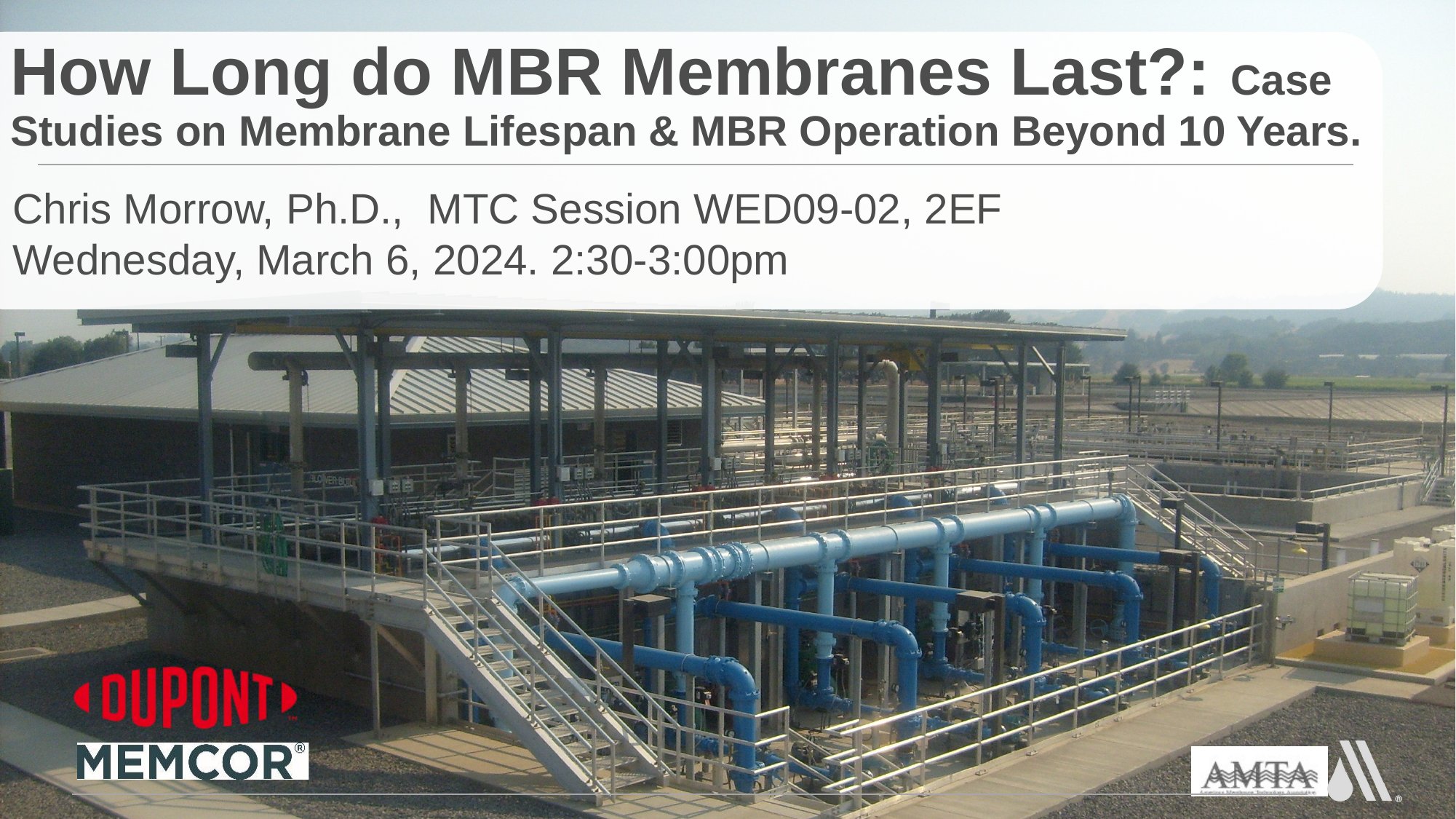
How Long do MBR Membranes Last? Case Studies on Membrane Lifespan and MBR Operation Beyond 10 Years.
| Details | |
|---|---|
| First Name | Christopher |
| Last Name | Morrow |
| Keywords | Municipal Wastewater, Membrane Bioreactor, Membrane Separation, Membrane Fouling, Membrane System, Brackish Water, Clarification, Permeability |
| Year | 2024 |
| File | WED09-02_Morrow_Christopher.pdf |
