
High total organic carbon (TOC) surface water in Florida is typically treated with enhanced coagulation, flocculation, sedimentation, (ozone), media filtration and disinfection. 2. Treatment using microfiltration (MF) and nanofiltration (NF) is a promising alternative (lower chemical addition and sludge handling requirements) but requires organic fouling control. Obtain disinfection log credits Microza Parameter Value Manufacturer Toray Capacities: Feed pump capacity 50 gpm @ 56 psig Backwash pump 75 gpm @ 30 psig Chemical pump 0 to 1.1 gph (two pumps) Air compressor 14 cfm @ 175 psig Feed, filtrate tank 250 gallons, each Module manufacturer Pall Toray Module type Microza® HFUG-2020AN Membrane material Polyvinylidene fluoride Polyvinylidene fluoride (PVDF) (PVDF) Membrane configuration Hollow-fiber, outside-in Hollow-fiber, outside-in Membrane area, ft2 538 Module length, ft and 6.6 7.1 diameter, inches 6.0 8. Nominal pore size, mm 0.1 0. Cleaning tolerance: pH, and 1 – 10 1-10 max chlorine, ppm Cl <5, Cl <5,000 2 2 Three Dupont Membrane configuration Spiral wound Spiral wound NF- Membrane active area, ft2 82 Membrane element diam, inch and 4 4 length, inch 40 Three Dupont Molecular weight cutoff (MWCO), 190 NF- Daltons Min salt rejection, % MgSO 98.7% 97.0% Max operating temp, 0C 45 45 pH range continuous 2 – 11 2 – 11 pH range cleaning 1 – 12 1 – Max operating pressure, psi, and 600, 5 600, 5 feed silt density index (SDI ) Free chlorine tolerance, mg/L < 0.1 < 0.1 Includes polysaccharides and proteinic matter; found only in surface waters: HMW sub-fraction, called cTEP, is suspected to be mainly responsible for membrane fouling Humics Biopolyme rs Dissolved Organic Nitrogen colloidal Polysaccharides Transparent Proteins Exopolymer Particles (cTEP) Stage NF90 Initially NF was fed by intermediate tank that caused excessive fouling New membranes August Salt passage remained below 15% consistently Differential pressure across the NF90s remained low Monthly to two-monthly CIPs began taking place in October Conclusions and Recommendations Dual membrane treatment of Lake Washington surface water is feasible with design and operational criteria that are within industry-accepted standards and guidelines Water quality treated with the dual membrane treatment system meets all national and state potable water standards and is considered excellent with levels of color, DOC, T&O, and CEC compounds (including polyfluoroalkyl substances [PFAS]) very low or non-detect Pilot operation depends on season / climatologic conditions Dry season (until July) MF/UF: flux 60-70 gfd; EFM every 3 days and CIP every month NF: flux 15 gfd; CIP every 3-6 months Wet season (until November) BAF: EBCT 11.7 minutes with proffered media being GAC F816 or equivalent MF/UF: flux 35-45 gfd; EFM 1-2 days and CIP every month NF: flux 15 gfd; CIP every 1-2 months.
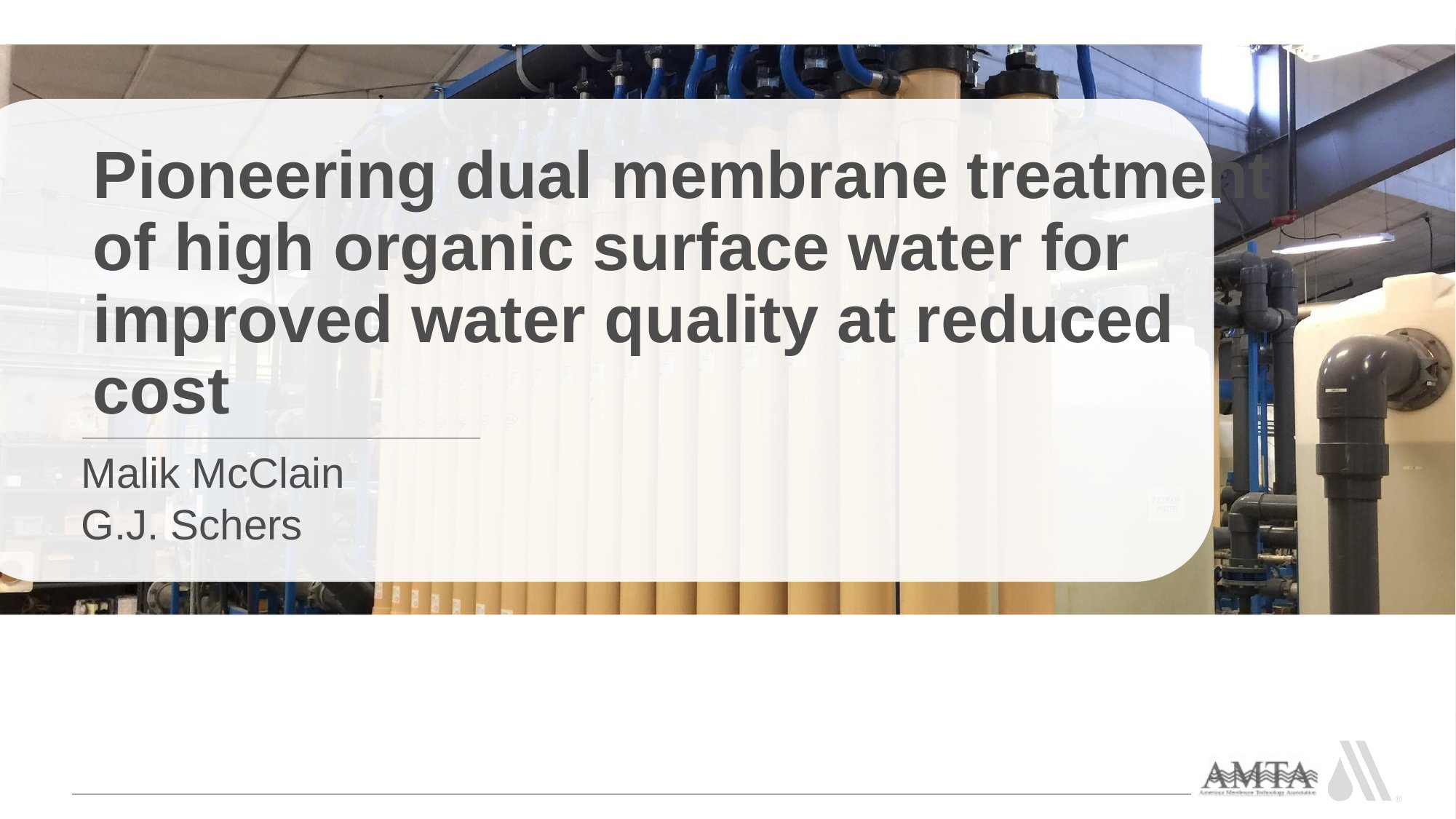
Pioneering Dual Membrane Treatment of High Organic Surface Water for Improved Water Quality at Reduced Cost
| Details | |
|---|---|
| First Name | Malik |
| Last Name | McCLain |
| Keywords | Schers, Total Organic Carbon, Silt Density Index, Membrane Fouling, Ultrafiltration, Microfiltration, Organic Fouling, Membrane Module, Nanofiltration |
| Year | 2024 |
| File | TUE05-02_McCLain_Malik.pdf |
