
Existing Water Treatment Facility Conventional Lime softening facility, current rated capacity of MLD Essentially 3 plants – 1946, 1958, 1976 Simultaneous lime softening and organics Major processes include: Intake from a shallow river source Coagulation + Lime Addition + Soda Ash + PAC + KMnO4 Sedimentation (SCU) + Re-carbonation Mono-media filtration (rapid sand) Primary disinfection (chlorine + UV) Secondary Disinfection Residuals Treatment Existing Water Treatment Facility Primarily the Assiniboine River Currently supplemented by well sources Simultaneous lime softening and organics Poor Water Quality Source Flashy, spring run-off issues High DOC, colour (large seasonal variability) 275 mg/L lime, 100 mg/L alum, 100 mg/L soda ash New Treatment Regime Poor source water quality, limitations in coagulation effectiveness Reduced capability of coagulation effectiveness in organics reduction due to high pH Inability to consistently meet DBP regulations, especially during summer THM/HAA precursor organics limited by current coagulation/softening/filtration regime Looking for alternatives to maintain or improve softening and provide additional DBP precursor removal Limited space for expansion with current site configuration Dual membrane system to provide additional softening and organics reduction UF for TSS reduction, followed by NF for softening and NOM reduction Current Challenges with New Residuals Insufficient space on-site for new residuals handling facility Dedicated membrane waste facilities cannot be constructed Limited ability for sewer system to handle any additional flows – only high COD CIP Waste and L/s of additional flow Limited hydraulic capacity of existing gravity thickener Hydraulically limited to 2. ML/d (based on overflow rates) Total membrane reject flow up to ML/d from UF and RO, combined with ~ ML/d of existing flow Currently recycling the thickener overflow TSS, chlorine and ammonia limits to receiving bodies Integration of the new residuals – difficult flow path The Easy Part….Nanofiltration Regulatory discussion allowed NF concentrate Value (mg/L) Parameter directly back to the source Average Maximum Low TSS, no issues with alkalinity, hardness, chlorides TDS (mg//L) 2860 4700 or metals Chloride (mg/L) 119 254 Allows 75% of waste to bypass existing residuals Sodium (mg/L) 288 680 system! Summary and Next Steps New treatment train added for expansion and DBP reduction Limitations on space for residuals treatment train Creative solution to integrate and upgrade existing residual treatment train Operational changes to existing treatment train, additional EQ space provided Polymer addition to gravity thickener Limit recycling to belt press supernatant Send NF concentrate directly to river De-chloramination Pilot testing to characterize waste streams.
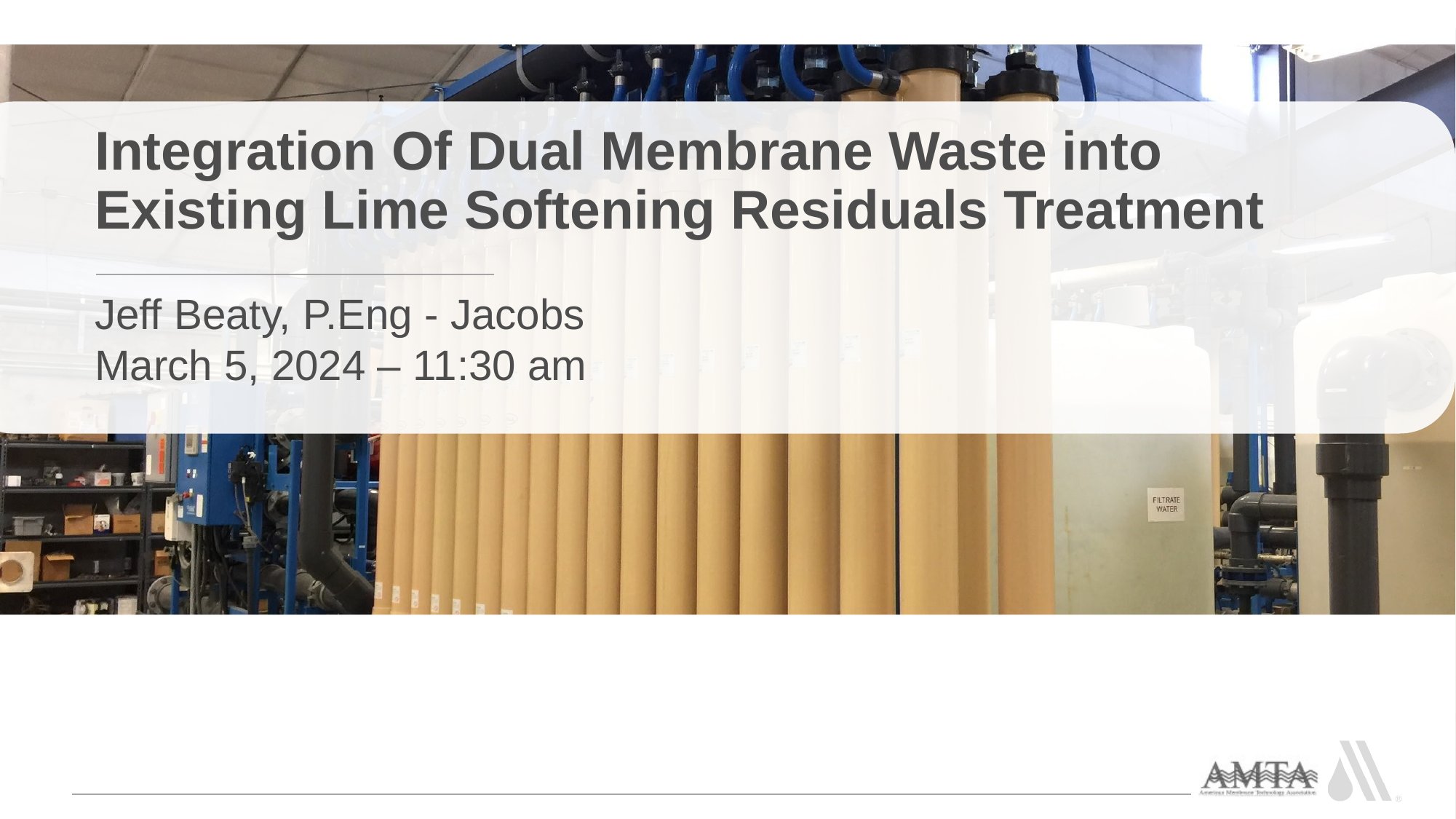
Residuals Treatment Considerations for Integrating a Dual-membrane System into an Existing Lime-Softening WTP Residuals Stream
| Details | |
|---|---|
| First Name | Jeffery |
| Last Name | Beaty |
| Keywords | Stangherlin, Ultrafiltration, Membrane System, Nanofiltration, Chloramination, Sedimentation, Coagulation, Pilot Study, Alkalinity |
| Year | 2024 |
| File | TUE04-03_Jeff_Beaty.pdf |
