
Agenda Introduction to PFAS and Regulatory Framework PFAS Detection in Southeast Florida Groundwaters Membrane Treatment of PFAS Case Study 1. Ulcerative colitis, High cholesterol Pregnancy-induced hypertension Thyroid disease, Testicular cancer, Kidney cancer Carbon-fluorine bond is strong and stable Regulatory Framework Perfluorooctanoic acid (PFOA) Environment Drinking Water Perfluorooctane sulfonate (PFOS) Draft CERCLA UCMR5 Draft Aquatic Life Criteria MCLs Perfluorobutane sulfonate (PFOA and PFOS) (PFBS) Hexafluoropropylene oxide dimer acid (HFPO-DA/GenX) Floridan aquifer groundwater Wells typically with casing depth around 1,000 ft bls Brackish water source TDS; Approximately 3,000 mg/L No PFAS detection in Floridan aquifer PFAS Detection in Southeast Florida Groundwaters (Cont.) Highest concentration near airports or known fire training facilities (AFF to ground). Other possible vectors/ sources include: wastewater reclamation/ Widespread PFAS reuse for irrigation. contamination Leaching from biosolids or landfill and potentially an Industrial releases excessively limited regulatory All Data by Jacobs, (2023/2024), unless otherwise noted. 1. Membrane Treatment of PFAS Best Available Technology Both RO and NF are effective for PFAS removal of long and short-chain PFAS Also removes organics and future-proofs for other emerging contaminants Managing liquid concentrates Source: Closed-Circuit High-Pressure Membrane Systems for the Separation of Per and Polyfluoroalkyl Substances, Safulko, A. et. al., Membrane Technology Conf. 2022 NF Rejection of PFAS Consistently High DuPont/Filmtec NF90/NF270 Hybrid Rejection after approximately two (2) decades of operation Demonstrated performance/reliability. PFOS compound rejected at least 97% PFOA compound rejected at least 95% Increasing system recovery, may decrease overall PFAS rejection. Tight NF Provides Effective Removal for Long and Short-Chain PFAS Hydranautics ESNA1-LF-LD Rejection after 7 years of operation Overall NF system recovery of 82% UCMR 3 showed no PFAS detection in the finished water/POE. PFAS MCLs Will Affect Membrane WTPs Membrane selection and operation typically rely on raw water bypass blends Introduces alkalinity and hardness, at a relatively inexpensive cost. New PFAS MCLs will reduce bypass blend ratios and affect corrosion control parameters (CSMR, DIC, LR, etc.) CERCLA may affect concentrate disposal. Both case studies presented yielded significant rejection of PFAS even after membranes reach and exceed end of useful life. Membrane treatment is the best available technology, and offers futureproofing for other possible emerging contaminants. Conclusions Membrane treatment is BAT to treat PFAS. Although CERCLA exemptions are likely for water utilities, futureproofing facilities means considering for possible future which limits deep well injections of PFAS-laden concentrate. Conclusions (Cont.) Florida utilities may need to adopt membrane treatment after final MCL and reduce bypass blend ratios.
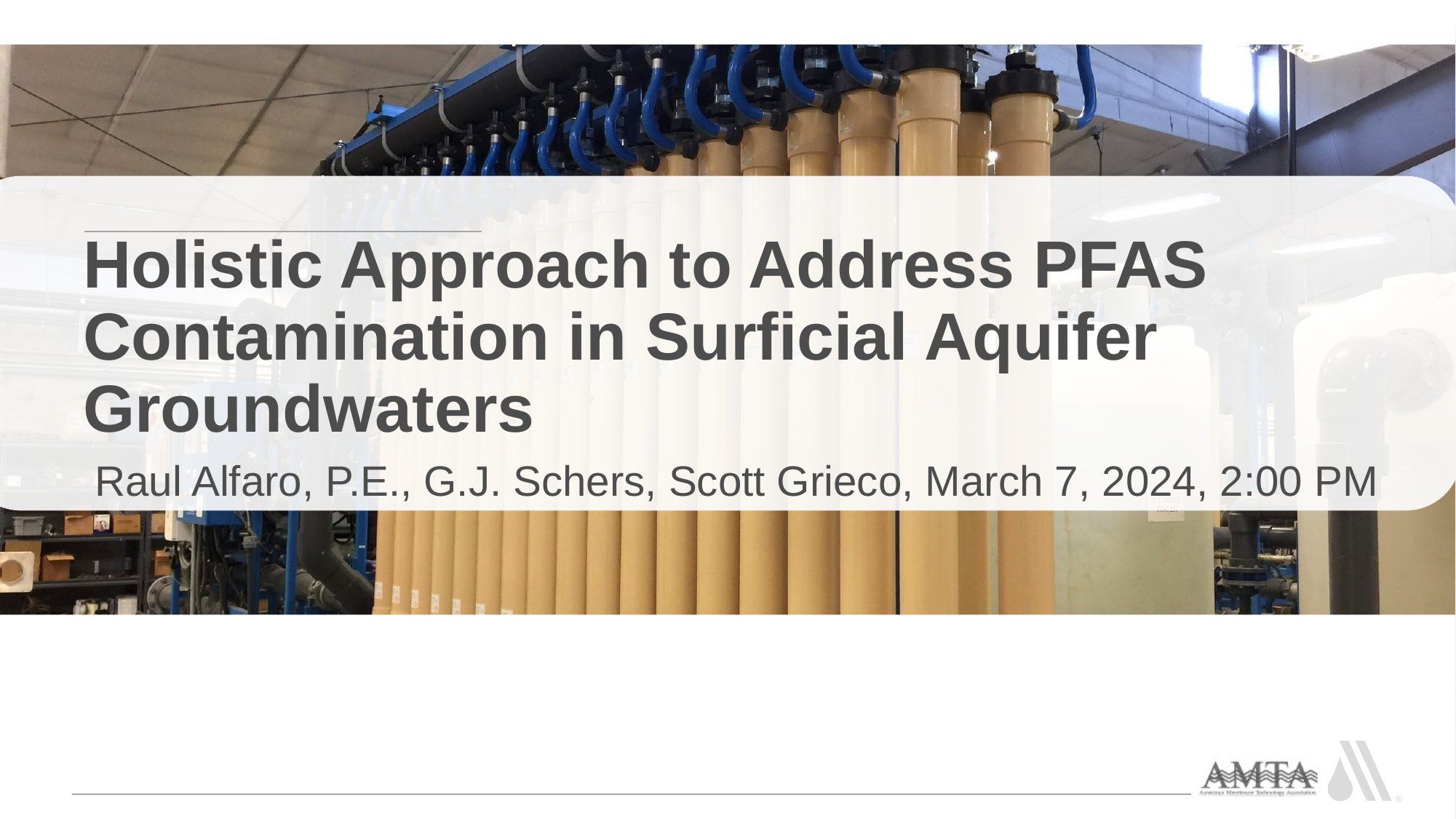
How Southeast Florida Utilities Are Using a Holistic Approach to Address PFAS Contamination in Surficial Aquifer Groundwaters
| Details | |
|---|---|
| First Name | Raul |
| Last Name | Alfaro |
| Keywords | Schers, Dissolved Organic Carbon, Total Dissolved Solids, Emerging Contaminants, Brackish Water, Drinking Water, Conductivity, Groundwater, Alkalinity |
| Year | 2024 |
| File | THU07-02_Alfaro_Raul.pdf |
